What if the biggest market in developer tools was hiding inside everyone's cloud bill?
In this episode, co-founder and CEO JP Jayaprakash argues that the step after code gets written, not the writing itself, is where the next large infrastructure business gets built.
Before AI code generation, writing code and validating it took roughly the same time. Now writing is a prompt away, and most of the software lifecycle goes to validation. JP's argument is that CI was never a small market, it was an invisible one. Teams spend something like $50,000 a year on a CI orchestrator and something like $2 million a year on the infrastructure underneath it, and all of that disappears into an AWS bill. CI workloads are also nothing like what the hyperscalers optimize for. One push can need a few thousand vCPUs for ten to thirty minutes, then drop to zero. Blacksmith built a cloud that deliberately trades durability for performance.
In this conversation, we cover:
- Why "CI was always a large market, they just didn't know about it," and where the spend actually hides
- What the hyperscalers get wrong about CI: "Lego blocks," bursty workloads, and durability over performance
- Why Blacksmith is "an index on software," whichever model or coding agent wins
- How "agents prompting other agents" produced 100 pull requests overnight at one customer
- Why power, not compute, became the constraint, and what a data center outage taught a 30-person team
JP also explains why he is against a Talk to Sales button with no Sign Up button, how a company can move its CI in under five minutes, why he wants sales removing blockers rather than selling the product, and where he thinks the bottleneck lands once agents write most of the code.
Blacksmith is building a purpose-built CI cloud, running the builds and tests that validate code before it ships, for teams whose code is increasingly written by agents.
[00:00:00] JP: We're a team of 30 people. We have 12 engineers, and we're running as much CI as GitHub was at the end of last year. That's incredible
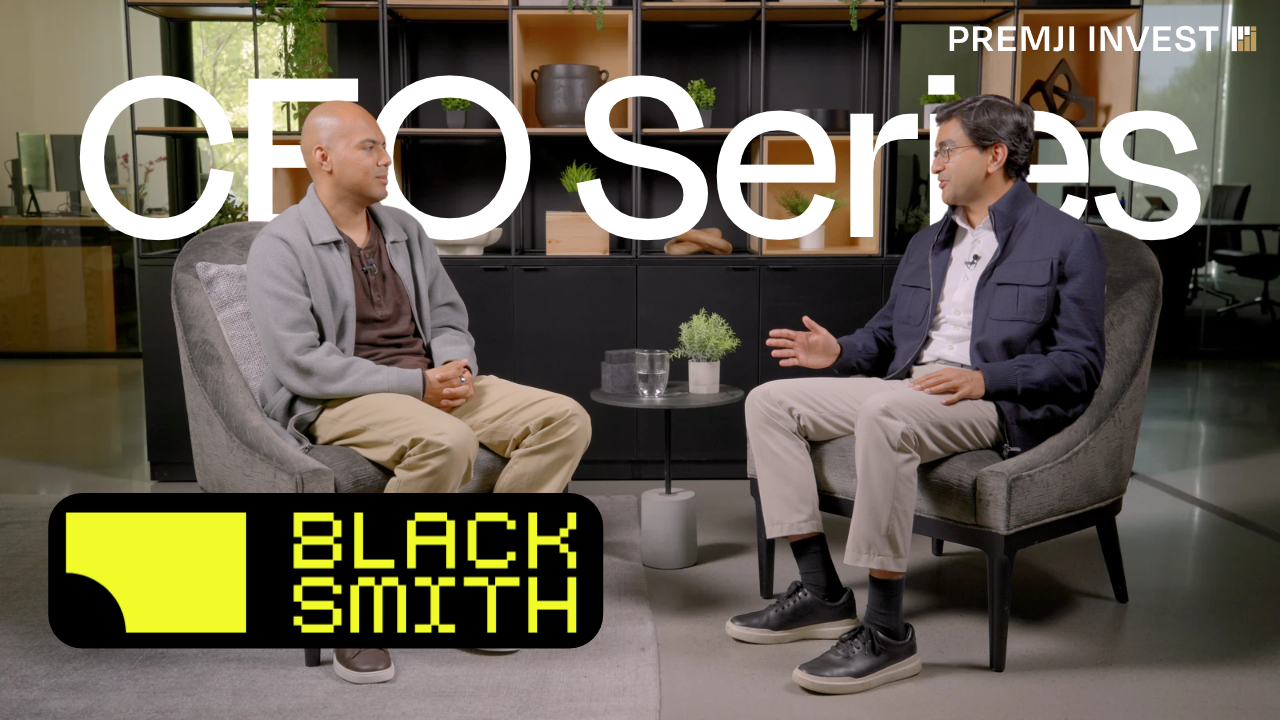
[00:00:13] Vedant: Hey everyone. Thanks for tuning in. My name is Vedant. I'm an investor at Premji Invest. Welcome to our next episode in our CEO series featuring JP, the CEO of Blacksmith. JP, thanks so much for doing this with us.
[00:00:25] JP: Really excited to be here. Hi, my name is Aditya Jayaprakash. Uh, people call me JP. I'm one of the founders and the CEO of Blacksmith.
[00:00:32] JP: Blacksmith is building a CI cloud. When developers write code, all of that code has to be built, it has to be tested and validated before it can be merged. Think of it like quality control, but for software. What Blacksmith does is we have purpose-built infrastructure that runs CI extremely fast and helps developers and agents merge code quickly.
[00:00:55] JP: Pre-AI code gen, the amount of time it took for developers to write code and for developers to, like, validate that code, I'd say it was roughly even. I mean, in some cases, validation took longer, in some cases, writing code took longer. But you know, they were in the same order of magnitude. But today, writing code is a prompt away because of these models.
[00:01:15] JP: And so if you look at the life cycle of software development, most of the time actually goes towards validation.
[00:01:22] Vedant: Yeah.
[00:01:22] JP: Now, what we're focused on is tightening up that loop.
[00:01:26] Vedant: You know, from an investor standpoint, it's also been a graveyard of companies, right? You know, you, you've seen many, many point solutions in this segment.
[00:01:33] Vedant: You know, some folks saying, "Hey, listen, I'll just do the orchestration," some folks saying, "I'll just store binaries and artifacts," some folks saying, "Maybe I'll not do, uh, cloud hosted, I'll do on-prem." So there's different kind of variations of businesses here. By and large, most companies have not done well.
[00:01:48] Vedant: These coding tools have got so good that the marginal cost of writing code has dropped to near zero, and so yeah, sure, maybe the bottleneck shifts. But what then changes in the SDLC, and then what makes then CI such a big thing that people need to go and solve?
[00:02:03] JP: I have, I have a hot take here. This is something that I tell investors all the time.
[00:02:06] JP: CI was always a large market, they just didn't know about it. For some of our customers that are not even that large, I'm talking about 50-person engineering teams, every time someone pushes code, you need thousands of vCPUs of compute to validate these code changes. That's pretty expensive. I can pull together a number of different examples of, of companies that we've talked to where their spend on a CI orchestrator is something like $50,000 a year, and their spend on infrastructure for CI is something like $2 million a year.
[00:02:36] JP: Tricky part for investors is if you look at a company's spend, all of that gets clubbed into their AWS spend. You know, the hyperscalers were doing, are, are probably doing north of 5 billion just from, just from CI.
[00:02:48] Vedant: Why is infrastructure the layer where most of this value will get captured in your view?
[00:02:52] JP: I think a mistake CI companies made in the last 10 years, like examples of, you know, companies like Buildkite and Circle, was they almost assumed that the infra layer would not change.
[00:03:05] JP: They always assumed that companies would always wanna run their workloads on AWS, GCP, and Azure. And a lot of companies think that. That's why a lot of companies have BYOC offerings, like bring your own cloud. I think the approach that we took was we challenged that belief. Like, our belief was, hey, if we built a cloud that ran CI workloads extremely fast, customers would be willing to, like, break that workload out of the cloud.
[00:03:30] Vedant: That's fascinating. And so what changes now? Wouldn't the hyperscalers capture the value again now as, you know, the SDLC process changes with code being written at, you know, lightning speed or...?
[00:03:40] JP: Yeah, they, they are. I, I think they're doing phenomenally well. This is actually a big, uh, tailwind for the hyperscalers as well.
[00:03:46] Vedant: And so what differentiates the Blacksmith solution versus some of the primitives that they might have already built?
[00:03:51] JP: The hyperscalers are really great at providing infrastructure primitives like EC2 and S3, and essentially giving companies Lego blocks and saying, "Hey, take these Lego blocks and go design CI infrastructure."
[00:04:04] JP: What Blacksmith did was, and, and what we saw when we started the company, was CI as a workload is very different from general purpose workloads that the hyperscalers serve.
[00:04:17] Vedant: Yeah.
[00:04:17] JP: Now, CI workloads, A, are incredibly bursty, so... And what I mean by that is what I alluded to before. A developer can push code, they need a few thousand vCPUs for maybe 10 to 30 minutes, and it goes down to zero.
[00:04:32] JP: That's a very spiky workload. And I mean, imagine 10 developers pushing code at the same time. You need 10,000 for a very short amount of time. When you're looking at a workload like CI, all that matters is how quickly can you execute code. Now, if you look at how the hyperscalers are built, because they're trying to serve general purpose workloads, they have made intentional trade-offs to favor durability over performance.
[00:04:56] Vedant: Hmm.
[00:04:57] JP: We've built Blacksmith in a way where we prioritize performance over durability, and we've just made a set of trade-offs that make it incredibly great to execute these workloads extremely fast.
[00:05:09] Vedant: Number of tokens that are being generated, either in test time compute or in final generation, is just going up, right?
[00:05:15] Vedant: And all... Most of those tokens which are being generated is code, and all that code needs to be validated. And so whether it's an open source model or a closed source model, it's kind of irrelevant, uh, for the Blacksmith build and, you know, all of that at some point needs to run through a product like Blacksmith in order to get into production.
[00:05:30] JP: That's really nicely put. That's exactly how I would describe it. Regardless of which model you're using, whether you're using a model from, like, the Frontier Labs or you're using an open source model And even talking about the harness, it doesn't matter if you're using Claude Code or Codex or Devin or Cursor, all of that code has to be validated.
[00:05:48] JP: I would almost think of Blacksmith as an index on software. The more software people write, the more software you have to validate, and a lot of that flows through us.
[00:05:58] Vedant: To the rise of the citizen developer, right? You've got a lot more people, uh, like my parents, who can now al- almost write, like, small mini apps for themselves, whether it's a cooking app or, you know, travel app or, you know, finding flight bookings and so on and so forth.
[00:06:10] Vedant: Like, you can build a lot more software, and software is more accessible to more folks, which only, you know, expands the TAM that you guys play in, right?
[00:06:17] JP: Completely agree with that, but the other part that I wanna add to that is historically, humans always had to work to produce software. Like pre-AI code gen, a developer had to, like, open up their computer, sit in front of a screen, and actually write code to develop software.
[00:06:34] JP: In the last two years, we're in this phase where you can tell an agent to go write software But we're actually going through this new shift right now where you have agents prompting other agents to write more software, and I think that's gonna be interesting and increase the amount of, like, software production by another order of magnitude.
[00:06:51] Vedant: Talk about that a little more a little-
[00:06:52] JP: Let me, let me, let me give you an ex- an example. So we, we, we recently spoke to this customer when, you know, we saw a pretty massive spike in their, in their CI usage, and we got a call with them and we were like, "Hey, this is really interesting. What's interesting is you seem to be writing code all the time, and your developers are all in Europe.
[00:07:09] JP: So what's, what's happening here?" They built an agent where every time a customer support request comes in, they have it automatically go auto-triage the issue and produce code to fix that automatically without, like, any intervention. Once, you know, developers wake up, they'll review and, and, and, and, and they'll merge it.
[00:07:27] JP: Now, the side effect of that is when they get hundreds of tickets, they're producing, like, 100 PRs overnight.
[00:07:32] Vedant: Right.
[00:07:33] JP: And, and this is agents prompting other agents to write more code. I think we're just starting to enter that, and that's gonna be really interesting and lead to an order of magnitude in more software being produced.
[00:07:43] Vedant: Yeah, I think the second derivative of this is actually huge for- Yeah ... like, uh, is that it's not just the citizen developer, because that's still capped to some extent. Where real exponential growth starts when agents can now then prompt other agents to then go to work.
[00:07:56] JP: There's also, like, a term that a lot of folks use, like the software factory, and I do believe that we are going towards that world where companies are gonna have software being written all the time.
[00:08:06] JP: We're doing 60 million jobs a week today. We were doing 3 million 12 months ago.
[00:08:11] Vedant: Right.
[00:08:11] JP: And-
[00:08:12] Vedant: So it's a 20x increase- It's a twenty- ... in jobs in a year. Yeah.
[00:08:15] JP: In, in a year, and 60x in the last 18 months.
[00:08:17] Vedant: Yeah.
[00:08:17] JP: It is extremely challenging to, like, build that reliably in a short period of time.
[00:08:23] Vedant: Yeah. And this was even before agents started prompting other agents to write code.
Right.
[00:08:26] Vedant: Exactly. So it'll only re-accelerate from
[00:08:27] JP: here. Ex- exactly. We're a team of 30 people. We have 12 engineers, and we're running as much CI today that GitHub was at the end of last year.
[00:08:38] Vedant: Wow.
[00:08:38] JP: That's incredible. I know we've talked about the compute shortage in the past. Initially, it was a memory shortage, and then it was actually getting compute.
[00:08:47] JP: But internally at Blacksmith, the constraint right now is actually power. That's the biggest variable. The way that we're trying to solve this problem is we're okay having smaller cells where it's at least a megawatt.
[00:09:00] Vedant: Yeah.
[00:09:01] JP: But then the operational challenge becomes, we might have, say, 20 different cells across different places.
[00:09:07] JP: How do we spin them up correctly? How do we route jobs to different regions? How do we spin them up incredibly effectively and maintaining storage across all of this? That's a big chunk of what we're focused on right now.
[00:09:17] Vedant: It's also a very small team, right? 30 people. Like, how does this team of 30 people manage this kind of reliability?
[00:09:23] JP: Any company grows 60x in 18 months, there will be incidents. Our largest data center is in Phoenix, Arizona, and Phoenix is really hot in the summer, and on August 13th there was a storm in Phoenix. The storm led to a power fluctuation in our facility. All the coolers, including the backup coolers, actually went under.
[00:09:44] JP: This led to the temperatures in our facility going up to 150 degrees, and they actually had to pull the plug on 80% of our, like, capacity to prevent these machines from burning down. Fortunately, we had other regions, and we were able to, like, go into, like, DR mode and try to, like, route it across different regions.
[00:10:01] JP: But that was a pretty big experience for us. I, I, I kind of, you know, wondered when we started the company, "Hey, what would happen if our, like, DC actually went down?" And it actually happened, and we lived through it.
[00:10:12] Vedant: Yeah, and I also think the... I read the, the customer release that you had on that, but I think the customer communication's very important, right?
[00:10:17] Vedant: Like, "Hey, this is what happened. This is why it happened. This is what we're doing to fix it."
[00:10:20] JP: Exactly, and, and at the end of the day, we actually got a lot of messages from customers where a lot of customers were like, "Hey, I'm, I'm pretty sure you, you had a terrible day, but just so you know, we really appreciated, like, the comms during the incident."
[00:10:31] Vedant: You guys have many, many customers and an incredibly small team. Your go-to-market team is maybe high single digits at best. Help us understand, you know, how do you get so many customers with such a small team? What is the go-to-market philosophy?
[00:10:43] JP: On the lower end of the market, I do believe that for a technical tool like ourselves that startups and mid-size companies can just use, the product needs to do a lot of the heavy lifting.
[00:10:54] JP: I'm actually really against companies that have a Talk to Sales button and don't have a Sign Up button. Uh, we've actually taken the exact opposite philosophy, and something else that we've done is we've made it such that people can onboard onto Blacksmith, onboard an entire company onto Blacksmith in five clicks, and we've actually seen companies move CI in under five minutes.
[00:11:15] JP: When we think about sales and go-to-market, I almost view it as a catalyst in the sense that they are there to remove blockers. I don't think for a tool like ours, go-to-market should be trying to sell the product. I think if it's doing that, the product's not doing its job.
[00:11:31] Vedant: Is there other companies that you admire, that have done a very good job at PLG or any companies that you take inspiration from?
[00:11:37] JP: The other one that I really admire is Datadog. Anyone can sign up for Datadog, and they're free to use it. You don't really have to talk to sales, and then Sales gets involved when their usage gets large enough- Makes- ... and it makes sense to, like, spread it across the org. We have a similar philosophy.
[00:11:50] Vedant: Is there anything different in their go-to-market motions as compared to yours?
[00:11:53] JP: I'm a pretty big fan of how they're doing things, and actually, a good chunk of our go-to-market team is actually from Datadog.
[00:11:58] Vedant: Oh, wow. Fantastic. Where's the buck going?
[00:12:00] JP: I think it's really gonna be limited by what we wanna do. I think the bottleneck is gonna be people sitting and writing down exactly what they want.
[00:12:07] Vedant: Yeah.
[00:12:08] JP: Because if you look at code, it, like, code is often precise. It's like math. There's only one meaning to it. I think the only thing limiting software is actually gonna be like, what do we want, what do we wanna build- Yeah ... and how precise do we wanna be with that?
[00:12:19] Vedant: JB, thank you so much again for doing this with us.
[00:12:21] Vedant: We're incredibly excited to be in business with Blacksmith, and we can't wait to see what you guys do in the future.
[00:12:26] JP: Yeah. Thanks for having me. This was really fun.