What if general purpose robotics needs far less intelligence than everyone assumes?
Co-founder and CEO Zhou Xian and co-founder and president Théophile Gervet make the case that the hard part of robotics is not the brain. It is owning enough of the stack to iterate at all.
Most robotics companies pick one of three paths: build the model, build the hardware, or sell data to everyone else. Genesis builds all three, plus its own physics simulator. Xian’s argument is that none of those layers is the product, the robot is, and owning the control system down to the actuator lets the team model latency to the millisecond inside model training. Théophile’s argument is about timing. In 2026 nothing in the stack is a commodity, so every component that still requires pushing the state of the art has to be internalized. He says Genesis has now moved more than 99% of its evaluation into simulation.
In this conversation, we cover:
- Why “in the end, none of this is our product,” and what owning the stack down to the actuator buys you
- Why “the race will be done once hardware is a commodity,” and why Théophile says that day has not arrived
- What a pure data vendor gets wrong: five million hours collected, maybe 10% of it useful for training
- Why evaluation, not data, is “the bottleneck of the entire industry that we don’t talk as much about”
- Why Xian believes robotics needs 10 to 20 million hours of data, not the hundreds of millions the field fears
Xian and Théophile also explain why you cannot solve robotics in a lab any more than you could solve self-driving in one, how scanning a customer site into a digital twin replaces weeks of on-site testing, and where they expect robotics adoption to land: slower than language models because the world is physical, faster than self-driving because you do not have to solve the whole problem to deploy, and more durable than either.
Genesis AI is a full-stack robotics company building GENE, a universal robotics foundation model, alongside its own physics simulator and its own hardware, including the Eno general-purpose robot.
[00:00:00] Vedant: What is the one thing that you think the robotics community gets wrong?
[00:00:04] Xian: I think people overestimate the complexity of the intelligence we need for solving robotics. I don't think we need real, like, sophisticated intelligence to really have a, uh, GPT moment for robotics.
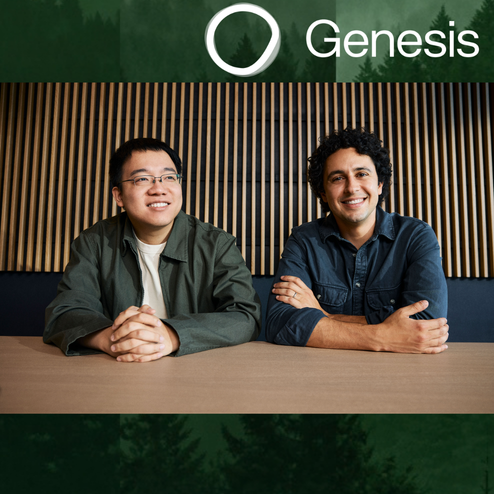
[00:00:21] Vedant: Hey everyone. Welcome to our next episode in our CEO series featuring Genesis. We've got Theo and Xian, the co-founders of the company. Hey guys, thank you so much for doing this with us.
[00:00:31] Theo: Thank you for having us. Thank you.
[00:00:32] Xian: Hi everybody. Uh, I'm Xian. I'm the CEO of Genesis. I met Theo while we were doing a PhD together in Carnegie Mellon, and we started a company last March to build hopefully the best robotics product.
[00:00:45] Theo: Hello, I'm Theo. I also met Xian doing a PhD at CMU, and most recently was leading a multimodal team at Mistral. Uh, and I'm co-founder and president at Genesis.
[00:00:53] Vedant: You know, most robotics companies, um, that we've seen choose one of three paths. Um, either they choose to build just the intelligence and the robot brain, or they choose to just build the hardware, uh, or they choose to be data vendors for other robotics companies.
[00:01:10] Vedant: Uh, you guys are unique in that you are full stack, right? You're building your own hardware, your own model, you're figuring out your own da- data collection strategy, and on top of all of that, you also do a bunch of other things like building a simulator and so on and so forth. Uh, can you help us understand, you know, why this design philosophy?
[00:01:25] Xian: In the end, none of this is our product Uh, like the, the mission of Genesis is to build the most intelligent and capable and the best, hopefully, robot product. So everything we're building from a technical perspective is to support that long-term vision. Of course, you need a be-best model, like the best robotic brain system to, to, to unleash the most, like, robotic capability.
[00:01:47] Xian: One simple example I, I, I can give is, for example, if you have the full control over the whole control system and down to the actuator level, you can easily model like latency to millisecond level into your model training process and make sure you have the, the most smooth execution of your model in the end.
[00:02:05] Xian: And that's the experience we wanna deliver in the end, and make sure it's, it's the most reliable.
[00:02:09] Theo: Maybe to add some complimentary perspective on why full stack today, it's also f- uh, a function of how early we are in the wave of robots. Of, uh, if we could buy off-the-shelf top tier components, we would.
[00:02:22] Theo: But none of the hardware is a commodity or simulation is a commodity today. People are talking about, "Oh, hardware will become a commodity." It's not at all today.
[00:02:29] Vedant: Can I get like an off-the-shelf arm? Sure. Can I get an off-the-shelf hand? Sure. But can I get something that is reliable, that can do like a million cycles of something again and again without burning out?
[00:02:38] Vedant: Absolutely not.
[00:02:39] Theo: The race will be done once hardware is a commodity. So on the path, I think you, you need to internalize every component that requires pushing the state-of-the-art.
[00:02:48] Vedant: What if I were to just take the model and let's assume, you know, the pace of hardware design continues as it has in the last five to 10 years, and say in the next two years I'm gonna have a five-fingered, um, end effector that works reliably.
[00:03:02] Vedant: Wouldn't it be better then to just be a model training company that then could use that end effector? Uh, wouldn't that be a more capital efficient business?
[00:03:10] Theo: So maybe your question is about timeline of yes, in five years, but in five years, from my perspective, the race is done and some cont- for some companies will have achieved scale and to be very hard to catch up just because of, uh, moats and more robots you deploy, the cheaper they get for hardware.
[00:03:23] Theo: The more robots you deploy, the more data you get to have a proprietary model that's stronger than others. So in 2026, at the point we're at, model is the bottleneck today. Uh, and two of the biggest bets we're taking are unlocked by actually owning the hardware and owning the simulator.
[00:03:39] Vedant: That's actually a very interesting point.
[00:03:40] Vedant: Are there other interfaces like this, like the interface between the model and the hardware or the interface between the model and the data collection strategy that you can walk us through?
[00:03:49] Xian: Uh, for example, uh, there's a strong synergy between the model training stack And the, the hardware collection recipe.
[00:03:57] Xian: If you're a pure data vendor, very likely you'll, you'll end up optimizing for a single KPI, which is like the amount of data. But in the end, when all this data goes into the model, it's very-- like the, both the, the diversity, the distribution of data, and the data quality all matters a lot. And if you do not own the model training stack yourself, there's no way for internally verify or evaluate how useful the data is.
[00:04:26] Xian: So you end up collecting like five million hours of data, but in the end, probably like only like 10% of the data will be actually useful for the model training. So you really need to have this Loop close internally so that you can iterate both data collection and, and model faster.
[00:04:41] Theo: Yeah.
[00:04:41] Xian: And if you're just, you know, if you're a data vendor and talking and selling data to model training company, then the feedback loop is, is, is very s- slow.
[00:04:49] Vedant: That makes a lot of sense. What about owning the model strategy and the data strategy, or the model strategy and the simulation strategy? Why is that important to do together, and why can't you just do one of the two and maybe outsource the others to something else?
[00:05:02] Theo: So maybe one component we haven't talked much about is the simulation, uh, and that ties to how much of a bottleneck evaluation is for robotics today.
[00:05:10] Theo: So we compare to LLMs, where you, you run your experiment in the morning, you wake up with dashboards of all the metrics that you care about. For robotics, you spend a few weeks training your model and your cluster, and then maybe every week you download some weights, put them on your robot, and you have a human all day, every day resetting the objects in the same place and letting the robot try to do a task to get one metric in one environment for one task that's not even reproducible because the lighting changes, the hardware wears out a little bit.
[00:05:36] Theo: Um, and just trying to train a general purpose brain that does hundreds of thousands of tasks across hundreds of environments, so you can imagine the, the thousands of operator days necessary to iterate every week. Um, and so that's the bottleneck of the entire industry that we don't talk as much about compared to data, but that's been a huge bottleneck for us as well.
[00:05:54] Theo: Uh, and from that perspective, today we've shifted maybe 99%-plus of all our evaluation into simulation. Uh, and the way we do this is by making sure that simulated worlds and r- and real world are as close as possible in terms of both physics, like how do different materials interact with each other, as well as rendering.
[00:06:13] Theo: You want the pixels to match perfectly between sim and reality. Uh, and the way to do it is to have a really good physics simulation team and a rendering team sitting right next to the model training team and the hardware team to ask about all the things that could go wrong in matching simulation and reality, and there is many of them.
[00:06:29] Theo: It can be system identification, rendering, physics, all of these. Any tiny tweak can completely mismatch simulation and reality, and you need to deeply understand all layers of a stack to make it work. And so we think to date, we've been, uh, the first company to actually make large scale evaluation and simulation with a very high correlation between sim and reality work.
[00:06:48] Theo: It's already a huge enabler for us in terms of, uh, testing models at scale.
[00:06:52] Vedant: You guys are working on a, a very technical topic, right? A lot of people believe that they can solve general purpose robotics. A lot of people have tried, and a lot of people have failed as well. Help us understand, how do you see the world for general purpose robotics over the next five, 10, 15 years?
[00:07:09] Xian: So first of all, I think there's, there, there, there's two, two, two parts of the problem. One is the so-called robotic brain, the other is, is really the, the body of the hardware I think we're two years away from, at most two years away from really solving the, the brain problem. Coupling, like, the reliability of, you know, manufacturing, iteration of hardware, I think we're looking at massive deployment a- across all different industries within next five years.
[00:07:33] Xian: And if, if you ask me to make a prediction, I think we'll, we'll start to have home robots in, like, three to four years. Like, there's a lot of people who's being scared and saying, "Hey, we probably need, like, hundreds of millions of hours of data for, for solving robotics," which is intractable. I think to us, we're, we're getting a more and more convinced belief that we probably need at, at most, like, 10 to 20 million hours of data, and we're getting that within next one and a half year to really fully cover the entire space, which can be translated into a e- like, super generalizable robotic brain, if you want to call it that way.
[00:08:07] Vedant: That'd be incredible.
[00:08:08] Xian: Yes.
[00:08:08] Vedant: You guys are very focused on deployment with your end customers. Um, walk us through why is deployment so crucial, uh, for Genesis?
[00:08:17] Theo: I, I don't think you can solve, uh, robotics in, in the lab like you can go for LLMs. Um, it's like imagining trying to solve self-driving in, in the lab.
[00:08:25] Theo: You, you cannot. Like, the, the way you make contact with actual real problem is by trying to deploy robots, solve real problems, see what fails and what does not, and that, in some sense, is your ground truth evaluation, and that's what grounds all the efforts of a model training team. We show up at the customer site, we can put gloves very smoothly on a worker, and they can do their daily job with no disruption to do their work, and that's how we train the robots.
[00:08:50] Theo: Um, and instead of bringing robots on site and testing them over many weeks, we can come in, scan an environment, put it as a digital twin in simulation, and iterate in a virtual world with no disruption.
[00:09:01] Vedant: How do you guys think about the adoption curves for robotics? Uh, do you think it'll be similar to the LLM adoption curves?
[00:09:07] Vedant: You know, ChatGPT got to 100 million users in a few months. Uh, or do you think it's gonna be similar to, you know, the autonomous driving adoption curves where, you know, Waymo took something like 16, 17 years and maybe $27 billion of capital to get where it is?
[00:09:21] Theo: I, I think maybe
[00:09:22] Xian: somewhere
[00:09:22] Theo: in the middle. Uh, it's still a physical product, so we'd have to deploy physical robots in the real world.
[00:09:27] Xian: I think certainly it's gonna be slower than LLM, because, like, we can't deny the fact it's, like, whenever it comes to the physical world, things becomes much more complex. In the long term, I think it will be a much more durable business than LLM, because we get a chance to build a actual physical product that can, you know, foster, like, user stickiness and, and we get to potentially build ecosystem around it.
[00:09:52] Theo: Maybe to add to this, it would be still much faster than self-driving because you don't have to solve the entirety of a problem to deploy. If you have a robot that works well for logistics, you can deploy it for logistics.
[00:10:02] Vedant: Xian and Theo, thank you so much for doing this with us.
[00:10:04] Theo: Thank you. Thank you, Vidhan.
.png)