
Are We There Yet?
Every parent knows the sound. Five minutes into a six-hour drive, a voice from the backseat: are we there yet? No. Not even close. And no amount of asking is going to make the car go faster.
The ERP industry has been that car for three decades. Hyperion was supposed to fix the analytics problem — Oracle bought it. Business Objects was supposed to fix the reporting problem — SAP bought it. Cloud was supposed to fix the flexibility problem. Each time, the industry promised we were almost there. Each time, the rigid core stayed rigid, the consultants stayed busy, and the spreadsheets stayed taped to the side.
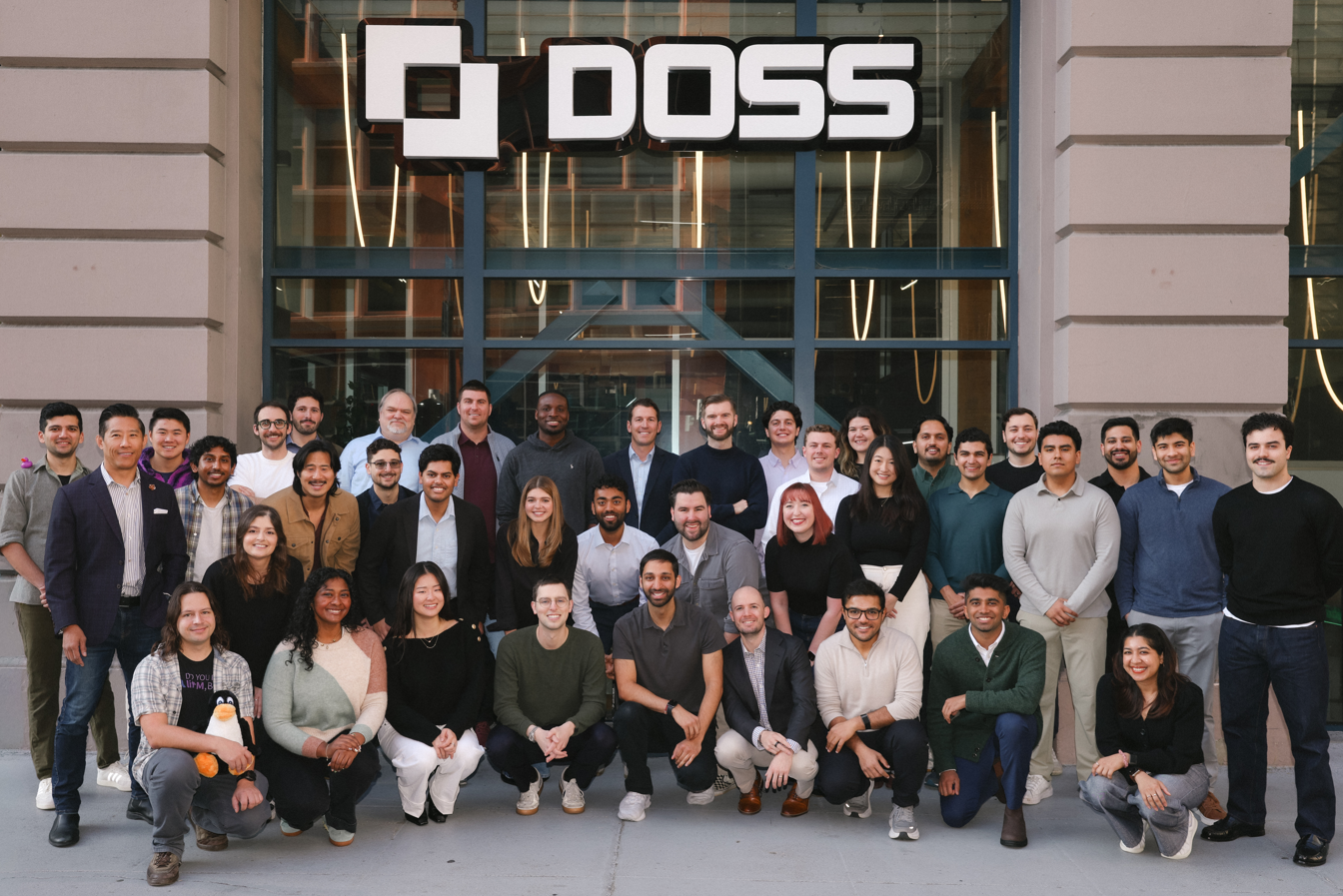
We're still not there. But with AI, there may finally be a fundamentally better way to build ERP — and that's why we're excited to co-lead Doss's $55M Series B as they build the first AI-native ERP.
When the Car Can't Keep Up
The ERP problem isn't new. But the forces making it urgent are. The businesses most dependent on ERP — companies that make or move physical things — are facing more operational complexity than at any point in history, and "good enough" is no longer survivable.
A specialty coffee company sources beans across continents, manages perishable inventory, sells through cafes, wholesale, and DTC, and operates internationally. A connected hardware company faces similar complexity across subscriptions, logistics, and international distribution. Businesses like these change shape every 18 to 24 months. If every change is a five-month ERP project, the business permanently outruns its software.
At the same time, PE roll-ups have exploded across consumer and industrial sectors — each acquisition bringing its own systems and data chaos, with the holding company needing unified visibility yesterday. And tariffs, reshoring, and supply chain disruption force continuous reconfiguration: new suppliers, new geographies, new compliance requirements, each one an ERP change event.
The gap between how fast businesses need to change and how fast their ERP allows them to change is wider than it's ever been. This feels like it should be a simple problem to fix. So why hasn't it been fixed?
The Rigid Core That Nobody Could Change
Because at the heart of every ERP is a rigid data model — the fixed schema that defines how every field, every table, and every business rule relates to everything else. That rigid data model is why adding an expiration date field is a five-month project, why migrations fail, and why ERPs are so hard to change. And it has survived for 50 years for three reasons.
Nobody thought to rearchitect it. Every wave of ERP "innovation" — mainframe to client-server, client-server to web, web to cloud — was replatforming, not rearchitecting. The industry moved the same rigid system to new hardware each time. Cloud eliminated server rooms but didn't make the software more flexible.
Those who did had no incentive to act. For every $1 in ERP software, companies spend $5 to $9 on implementation services — delivered by the same system integrators who serve as the vendors' distribution channel. Rearchitecting the ERP to be simpler would destroy the economics of the partners who sell it. Complexity is the moat.
The technology didn't exist to do it differently. A decade of maturation in the open-source data ecosystem — Postgres evolving into enterprise-grade infrastructure, graph databases capable of representing complex business logic, AI models that can reason over self-describing data systems — has made fundamentally different architectural choices possible for the first time.
Fix the Data, Earn the Right to Do Everything Else
Doss starts where the problem starts: the data. They don't walk into a customer and say "we're your new ERP." They start by taking a customer's messy, fragmented data from whatever systems they're running and building a clean, unified, flexible representation of it. Under the hood, that means a graph-based data model where business objects and their relationships are self-describing — so when the business changes, the schema adapts without breaking everything downstream. It's minimally invasive, immediately useful, and extremely sticky.
From there, Doss expands module by module. The operations team starts using Doss; the finance team stays on their existing system. The data reconciles across both. Over time, more work naturally migrates because changes don't require consultants and the interface is built for operators.
None of this requires ripping out the existing ERP — and that's by design. We've seen that movie enough times to know how it ends. Lidl spent €500M over 7 years on SAP and scrapped it entirely. Hershey's went live with a new ERP right before Halloween and couldn't ship $100M in orders. Even Amazon tried to migrate to Workday and abandoned it. Doss sidesteps this graveyard by building alongside the existing system, not on top of its rubble.
For fifty years, the ERP industry has been replatforming. Doss is rearchitecting.
Team, Tech, TAM, and the Prius Problem
At Premji Invest, our framework for evaluating early-stage bets comes down to four things: team, technology, TAM, and syndicate. We've laid out the technology and approach. Here's the rest.
The TAM is enormous. We've already described the scale — a $150 billion market where the largest player has single-digit share, and even niche vertical players like Epicor, IFS, and Infor generate $1 to $3.5B in revenue each. The market supports many large outcomes simultaneously. The real question is how much Doss can service given competition.
We see two competitive fears — and neither holds. The first is that incumbents will bolt AI onto existing ERPs and make the problem go away. SAP has Joule, Oracle has 50+ agents, Microsoft has Copilot. But that approach is like putting Lewis Hamilton in a Prius - you can put the best driver in the world behind the wheel, but the car still isn't winning an F1 race. SAP's Joule can tell you your inventory levels. It cannot safely switch your tracking from first-in-first-out to first-expiring-first-out — because that's a schema change that might break downstream reporting, and the legacy architecture has no way to validate it. Incumbents can't rearchitect without breaking every customization their installed base has built over 30 years.
The second is that AI will speed up implementation of existing ERPs. This is real work, and companies are pursuing it. But it's like using robots to automate the manufacturing of a Prius. You'll produce more, faster — but it's still a Prius. The customer still ends up on a rigid system where every change carries downstream risk.
We didn't arrive at this thesis by seeing a demo. Our portfolio showed us the demand — physical-product companies struggling with ERP complexity across every sector we invest in. Our ERP unbundling investments — Anaplan, Coupa, Zuora, Icertis — each became significant outcomes, but taught us that even the best point solutions remain systems of engagement orbiting the rigid core. Our infrastructure investments — DataStax, Looker — gave us conviction in what the modern data stack enables. And our System Integrator heritage gave us an unvarnished view of why the $9-to-$1 ratio persists.
On team: Arnav and Wiley are the right pairing for this problem — Arnav is one of the sharpest technical minds we've encountered (spend five minutes with the deep-dive videos on the Doss blog to see how fast his mind works), and Wiley is the consummate go-to-market leader with deep operational fluency. Both have spent time in businesses that move atoms, not just bits.
On syndicate: we're honored to partner alongside friends at Madrona, Theory Ventures, and General Catalyst — firms we've built deep trust with through prior collaborations including Outreach, Looker, and Hippocratic AI.
Doss is where our decade of pattern recognition converges. The last software problem is finally being solved.
Recommended
.jpg)
Agents need more than intelligence. Why we invested in Databricks
Agents need more than intelligence. Why we invested in Databricks


The Downstream Effects of SpaceX, OpenAI, and Anthropic Soaking Up $3T in the Public Market, Who Is Netscape and Who Is Google in the AI Era, and the Impact of Private Credit Redemption Requests on PE and VC (Sandesh Patnam)
The Downstream Effects of SpaceX, OpenAI, and Anthropic Soaking Up $3T in the Public Market, Who Is Netscape and Who Is Google in the AI Era, and the Impact of Private Credit Redemption Requests on PE and VC (Sandesh Patnam)

Robotics isn’t having its ChatGPT moment just yet
Robotics isn’t having its ChatGPT moment just yet

Formal verification just left the lab. Why we invested in Pramaana Labs.