What if the best data in drug discovery is the data nobody publishes?
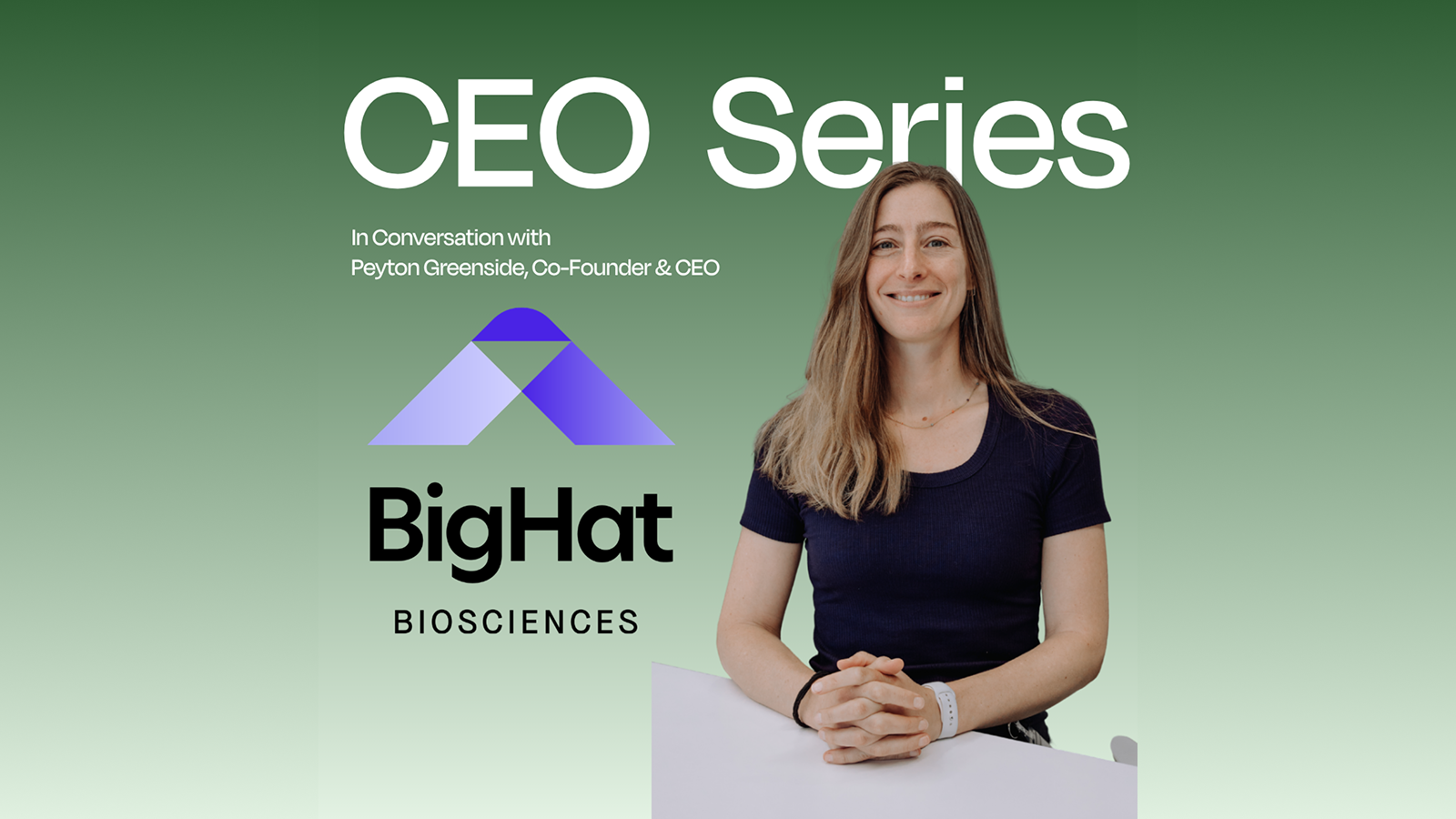
In this episode of CEO Series, we sit down with Peyton Greenside, co-founder and CEO of BigHat Biosciences, to separate what's real in AI-driven biologics from what's noise, and to understand why the hard part of the problem starts after a molecule binds its target.
Models and agents are commoditizing by the month. What doesn't commoditize is a lab that makes thousands of molecules a week, measures each one across 10+ properties, and feeds every result, including the failures, back into the next round of designs. BigHat built that lab first, six years ago, and has been running it ever since: roughly forty design-make-test cycles a year, on a proprietary cell-free synthesis stack that lets the team build antibody formats almost no one else can. The outcome is a company that treats binding, developability and function as one problem rather than three, and that has taken its first molecule into patients.
In this conversation, we cover:
- Why two weeks of data from your own lab does more for a program than a year of progress in model architecture
- How BigHat designs biologics that encode logic, killing a cell only when it sees two targets, and what that unlocks for targets once considered too toxic to pursue
- Why you can't design a conditionally active quad-specific "out of thin air," and what a platform has to look like to engineer one
- How a company that can work on anything decides what to work on first, and why the pipeline pairs an internalization-optimized ADC with an avidity-driven T-cell engager
- What BigHat can do for pharma that pharma cannot do for itself, and what makes a partnership a success rather than a distraction
Peyton also shares why generalization comes faster when you focus, how a team that is "bilingual and trilingual" across protein engineering, machine learning and clinical development actually works together, and what it means to become a clinical-stage company after six years of building toward it. BigHat recently announced a $75M Series C, co-led by Premji Invest and DFJ Growth, to advance its pipeline and scale the platform behind it.
BigHat Biosciences is an AI-native biotechnology company that pairs frontier AI with an autonomous, high-throughput wet lab to design and develop next-generation protein therapeutics, with a clinical-stage pipeline and collaborations with Amgen, Merck, Johnson & Johnson, AbbVie and Eli Lilly.
[00:00:00] Peyton Greenside: We're one of the leaders in, in logic gating, in designing biologics that literally encode logic
[00:00:11] Marc Martin Casas: Hi, everyone. Uh, welcome to another episode of the CEO series. Uh, my name is Mark, uh, with Premji Invest. I focus on growth stage investing in the biotech and healthcare spaces. We're living in a frenzied era, uh, of AI and drug discovery, right? Which I think when the hype, the initial hype settles, we're left with the question of what's real, what's not real, what's signal, what's noise, right?
[00:00:32] Marc Martin Casas: So here to answer that question and others is, uh, Payton Greenside, who's the CEO and co-founder of Big Hat Biosciences.
[00:00:38] Peyton Greenside: Hi, my name is Payton Greenside. I'm one of the co-founders and the CEO of Big Hat Biosciences. We're an AI-driven antibody and protein engineering company with one of the leading data generation and model building platforms and our own therapeutic pipeline.
[00:00:49] Peyton Greenside: There's a lot of excitement right now. Mm-hmm. There's also a lot of hype.
[00:00:51] Marc Martin Casas: Yeah. I
[00:00:51] Peyton Greenside: think that one of the things that I, um, learned early on in my career, and that's really I think, um, set Big, Big Hat on the path we're on now, is you really need to test and validate and have the data to show- Yeah ... that your hy- hypotheses, your m- m- machine learning models are actually working, and that's really what we focus on, is how do we essentially have the fastest design, build, test- Data engine-
[00:01:08] Marc Martin Casas: Right
[00:01:08] Peyton Greenside: to create all the data that modern models need to engineer proteins that you couldn't otherwise engineer without these methods.
[00:01:13] Marc Martin Casas: And I think it's not only about kind of, like, you mentioned throughput, and you mentioned, like, the depth of data as well, uh, but I think it's about the latency, right, between these cycles of learning, right?
[00:01:23] Marc Martin Casas: So can you talk a little bit about that? Because you can process so much and analyze so much for every single candidate every single week, right? Is that right? Yeah,
[00:01:30] Peyton Greenside: exactly. Yeah. And, and I love that because zero latency is really our goal. I think, you know, um, a lot of times people think about big data, and big data matters.
[00:01:37] Peyton Greenside: But actually, one of the core hypotheses, and even my academic background, was much more in kind of Bayesian optimization or active learning- Mm-hmm ... which is feedback. Mm-hmm. How do I actually turn the speed of the cycle to be a much higher cadence than just a bigger data set over a longer time period? And that's actually quite critical.
[00:01:50] Peyton Greenside: It's a small insight, 'cause maybe the data set sizes are similar, but in an active learning context, the way our lab works, you get feedback. So as you build a model, say I wanna predict, um, a model or use a model to predict whether an affinity or a functional assay is gonna be more potent.
[00:02:02] Marc Martin Casas: Mm-hmm.
[00:02:02] Peyton Greenside: I actually can be much more thoughtful if I can do, you know, 50 rounds of iteration a year- Right
[00:02:07] Peyton Greenside: and make that model, pick that data where it's actually gonna make the model better versus just guess upfront. And so we're agilely kind of being able to, you know, gather data, update models, to really optimize exactly what we need for a given program. And that, like, flexibility allows us really, I think, to design much more exciting, um, molecules.
[00:02:22] Marc Martin Casas: Right. And, like, I think even the quality of the data, right, like, and where it comes from, it, it matters, right? Like, and obviously you know your data sets so well and your experimental workflows so well. 'Cause I think there's a whole camp of people, right, that, um, just tend to think that, you know, the more data, the better.
[00:02:37] Marc Martin Casas: Like, let's aggregate all this data from all these public data sets, and the- there's for sure va- value in that, right? But, um, I assume, like, please tell me if I'm wrong, that if you complement that or maybe you just focus on proprietary data sets, you can extract a lot more information maybe. Do you think that's
[00:02:50] Peyton Greenside: right?
[00:02:50] Peyton Greenside: That's completely right. Yeah. And one of the things that we, um, have really focused on is we generate all the data we need in-house. Mm-hmm. We don't depend on public data sets at all. Mm-hmm. I think that's really important because by controlling the data generation, we control the exact assay. And the same protocols we used, you know, three, four, five years ago at BigApp-
[00:03:05] Marc Martin Casas: Mm-hmm
[00:03:05] Peyton Greenside: are still often the ones we use today. That allows us to aggregate essentially all the data we've ever made into sort of monolithic data sets that train these models. That's a huge advantage, right? Mm-hmm. And so now when you kind of have a zero latency lab like we were just talking about- And that zero latency lab is actually powered by larger and larger data sets, so you can both test hy- test hypotheses quickly and also use large pre-trained models.
[00:03:23] Peyton Greenside: So you have a scale, and you also have speed. And now when you put those pieces together, you're really able to go after a lot of different, more sophisticated protein design challenges- Right ... than otherwise you'd be able to with just one or the other.
[00:03:32] Marc Martin Casas: I know that, you know, the, the Big Hat platform is able to design next gen biologics, right?
[00:03:37] Marc Martin Casas: They are able to, um, you know, have different properties that can be optimized simultaneously, right? So maybe you can talk a little bit about, uh, about those capabilities and how they're differentiated, too.
[00:03:47] Peyton Greenside: Yeah. One of the things I'm most excited about is, like, pushing the frontier of, like, what types of molecules we can even design.
[00:03:52] Marc Martin Casas: Yeah.
[00:03:52] Peyton Greenside: I mean, for a long time, right, in this field, it was just monoclonal antibodies. Right. The same molecules that your body produces, that my body produces. And you know, the field started moving towards next gens, right? And those started to look like little Frankenstein molecules, but we're now we're in a whole nother frontier.
[00:04:03] Peyton Greenside: People are working on incredible molecules, like, not just bispecifics, but trispecifics, quad specifics, conditionally active molecules. And this is really an area that Big Hat is, I think, incredibly differentiated and plans to continue to really push our platform. And, you know, this is the kind of area where you need a platform that can test hypotheses.
[00:04:18] Peyton Greenside: You can't kind of, you know, out of thin air design a conditionally active, like, quad specific, right? That requires some engineering. Yeah. That requires some iteration. And that's kind of the, you know, again, where our platform perfectly fits. So I'm really excited about, um, what these kind of new formats, once we can engineer them, can unlock, 'cause now you can go after completely new biology you couldn't otherwise.
[00:04:34] Marc Martin Casas: Mm-hmm.
[00:04:34] Peyton Greenside: Mm-hmm. Um, one of the best examples I think of what we've done is, like, I think w- we're one of the leaders in, in logic gating, in designing biologics that literally encode logic. I need to see target A and target B to actually kill the cell. Mm-hmm. But if I see target A but not target B, like, I won't kill the cell- Mm-hmm
[00:04:47] Peyton Greenside: or vice versa. Mm-hmm. Mm-hmm. And so all of a sudden now, you know, when you had, um, kind of targets where patients might experience toxicity, you can think about going after those targets 'cause you have, you know, a signal that prevents healthy tissues or healthy cells from being killed. It's incredibly powerful.
[00:04:59] Peyton Greenside: That's a great example of where sophisticated molecular design can really open up new biology and, and new therapeutics. And, um, that's again, uh, I think one of the best kind of existing demonstrations of what we've achieved to date. And, you know, we're on a pretty rapid path, I think, continuing to push the frontier of the types of molecules we can make.
[00:05:13] Marc Martin Casas: Right. And I, I think that, I mean, you mentioned how much you've learned from your pharma partners, but your pharma partners have also learned a lot from you, I assume, right? And I think that, um, maybe, like, for those folks that are kind of, like, listening or tuning in, uh, that might be thinking of approaching pharma or they're currently in conversations with pharma Um, could you provide a bit of advice, right, like, of what a pitch would be, right, for s- specifically for Big Hat, right?
[00:05:37] Marc Martin Casas: Like, what kind of value can you provide?
[00:05:39] Peyton Greenside: Yeah, we can solve protein engineering problems that, you know, pharma and others today simply cannot, and those take a lot of forms. So one example is multi-parameter optimization. A lot of pharma companies have worked with us to really solve not just one, two, three, four, five properties.
[00:05:52] Peyton Greenside: Like, how do I co-optimize all these properties together? That's what you need our scalable design-build test lab to do, and that's one great example. The other of which is data generation. We can generate data at scale that today's models need. And as we've s- you know, throughout the last six years of the company, we've seen pharma go from wanting to try out AI and see how it works- Mm
[00:06:09] Peyton Greenside: to really gaining a strong conviction that this is how drug discovery is gonna work. And importantly, with that conviction, understanding data is gonna power a lot of their own work. And so we have one of the best data generation engines. Mm. And so I think, you know, as we work with pharma companies, we can provide thousands and thousands of sequences, right?
[00:06:24] Peyton Greenside: Really being sure we have an optimal sequence. We're making something no one else can and showing that we can kind of co-optimize those sequences for many different things. So, you know, I think there's a lot of layers to what we can provide. And it, it all stems from having a lab that produces the data that modern models need to design really sophisticated proteins.
[00:06:38] Peyton Greenside: And I think because we've been very focused on that engine from the very beginning, we've been able to refine it and refine it and grow it, and I think make it much more powerful than what any- anyone else can do today.
[00:06:47] Marc Martin Casas: And I mean, beyond the value, right, like, I mean, where do you think the success of a pharma partnership lies?
[00:06:52] Peyton Greenside: For Big Hat, success for pharma partnerships can be a few things. Helping us advance our platform and show what we can do on a new area.
[00:06:58] Marc Martin Casas: Mm-hmm
[00:06:59] Peyton Greenside: Um, importantly, moving more Big Hat engineered molecules to the clinic. We'd love to have as many Big Hat engineered molecules in the clinic as possible, right?
[00:07:05] Peyton Greenside: Across all sorts of designs, all sorts of thera- therapeutic areas. And while we're gonna focus mostly on oncology and sort of immunology for our own internal pipeline, we can work on every- everything from, you know, neuroscience, to rare disease, to cardiometabolic. Mm-hmm. All sorts of different therapeutic areas.
[00:07:17] Peyton Greenside: Mm-hmm. So we get to actually expand, you know, the footprint of the number and sort of type of clinical programs we can work on. Mm-hmm. And so success can be a lot of innovation in the molecular design, but also really seeing Big Hat made molecules, like, advance in the clinic, and I think that's a really beautiful thing to see is, like, you know, you've engineered something that really is, um, um, I think to the point that pharma company that's had years and years of experience- Mm-hmm
[00:07:37] Peyton Greenside: is excited to move forward, right? And to put into patients.
[00:07:39] Marc Martin Casas: We talk about data, and we talk about the platform as moats, right, of Big Hat. But I think another moat here is, like, kind of team building, right? And kind of just... I mean, you've built such a good kind of environment here where almost like a bilingual team, right?
[00:07:54] Marc Martin Casas: Where you have the computation folks, you have the experimentation folks, you have the clinical and pre-clinical development folks, right? And kind of getting a- an organization, um, like that to function so seamlessly, I think is a huge moat, right? So can you kind of provide a bit of perspective, right, on what the culture here has been and how you've built it and scaled it, like, in the different stages of, of Big Hat?
[00:08:14] Marc Martin Casas: Yeah.
[00:08:15] Peyton Greenside: Yeah. Yeah, I think, I think, you know, there's two ways to think about the team, one of which is the people we hire, and many of them are not just bilingual, but already trilingual and wanna learn a fourth language, right? And, um, I think that's a, a wonderful fit for the Big Hat team is someone who, you know, is an expert in protein engineering and wants to learn machine learning and does their own data analysis and really wants to see, you know, how do I leverage today's agents, right, to make my own work, um, better.
[00:08:33] Peyton Greenside: I think we see that type of, like, curiosity and excitement from almost everybody, um, on this team. And I will say, there's also kind of the environment. Like, we have engineered an environment that helps team members from different backgrounds work together. Right. Like, for an example, our first employee was our CIO, um, who helped us engineer Reki, which is our, you know, custom proprietary LIMS system, and this is kind of a data plane that everyone in the company works off of.
[00:08:54] Peyton Greenside: And that's whether you're experimental or computational, you're always sort of ingesting, you know, reading, um, data from the same platform, looking at visualizations, like, doing a lot of, again, your analysis in this tool. And so it actually, uh, I think can be helped to be crafted, I guess, from an environment of, like, do you have tools that different team members of different languages use and collaborate around?
[00:09:12] Peyton Greenside: And then you have to kind of have that type of, a- again, sort of like interaction or language interchange- Right ... to do that. And so by building, you know, I think, really sophisticated software tools from the beginning that track every experimental workflow, every computational workflow, put them in the same plane, that also enables, I think, a very already bilingual team- Right
[00:09:28] Peyton Greenside: to kind of accentuate, right, those, um, benefits o- of their backgrounds.
[00:09:30] Marc Martin Casas: How do you pick your investors, I guess, or the partners, whether it's pharma partners, investors, um, people that you work with? Uh, what are some important things that you would, you would- Yeah ... you know, prioritize?
[00:09:41] Peyton Greenside: Well, we're lucky to work with some of the best of the best, both in terms of pharma partners as well as in terms of, in terms of our investors.
[00:09:46] Peyton Greenside: And I think, like, I, I really see an enormous opportunity ahead of us. Mm-hmm. Mm-hmm. I mean, we're not just developing our own pipeline, but I think we're truly generating one of the best data generation engines that can train the world's best models for protein design, and we can do so many things with those.
[00:09:57] Peyton Greenside: And so we're extremely excited to both have and bring on, I think, existing, um, and new investors that really see that vision and that opportunity. And frankly, we're very lucky to work with Premji. Mm-hmm. 'Cause I think, you know, Premji, you and, and the team see that vision and see that opportunity ahead of us, both from the therapeutic side, the platform side, and how those combine to really realize an enormous kind of potential, not just for technology, but also for the patients that our therapies will be treating.
[00:10:17] Peyton Greenside: And I think that type of incredibly broad vision and understanding the, the combination of biotech and tech and where those come together to really create that opportunity, I mean, that's incredibly exciting, and I think something we've seen in, you know, speaking with Premji and speaking with you and everybody, and one we're excited to realize together.
[00:10:32] Peyton Greenside: So, um, I think that's been true of our pharma partners, our existing investors, and, and will be, you know, ever more true as we, um, head into the next phase at Big Hat together.
[00:10:39] Marc Martin Casas: That's awesome. And you know, the, the feeling is mutual. What kind of, like, excites you the most about where you are i- in terms of Big Hat or maybe the space, like maybe some- something that you just find tremendously exciting?
[00:10:49] Peyton Greenside: The technology. I think as we talked about, there's a, a shift we've seen even in the last six months where, you know, as, you know, today's frontier labs are putting out these incredibly powerful agents and it's easier to train models. What's really happened is that platforms like Big Hat's are now becoming front and center as the key, I think, to really unlock a lot of the potential- Mm-hmm
[00:11:06] Peyton Greenside: of these models and of these agents in biology. We are right there, prime and center, with our synthetic biology stack, our automated lab, the ability to generate all this data. I'm extremely excited about the point in history. As you said, it's a really specific and exciting point in history where what we've been building for six years is now perfectly timed and poised to actually benefit from this technological wave.
[00:11:25] Peyton Greenside: And so combining what our platform, again, has been building for many years with this opportunity, I, I see a very bright future ahead of us, really being able to push the frontier of what types of molecules we can make and even potentially pass, you know, our standard antibodies into more diverse proteins and other opportunities.
[00:11:38] Peyton Greenside: So we truly, as you said in the beginning, can work on anything, and I'm excited to start chasing that future and, and see the full power of what Big Hat's platform can do.
[00:11:45] Marc Martin Casas: And we'll be right there with you along the way. Thank you, uh, for joining us today and, uh, for an in- incredibly exciting conversation.
[00:11:52] Marc Martin Casas: So congrats on all the progress with Big Hat as well. And to everyone that tuned in, thank you so much. Um, stay tuned for other episodes of the CEO series.

.png)

.png)