Every failed reaction teaches something, when the lab is built to remember.
AI can now reason about chemistry. What it lacks is evidence from the real world, including the reactions that fail. Warp is building the labs to provide it, starting with work drug developers already need.
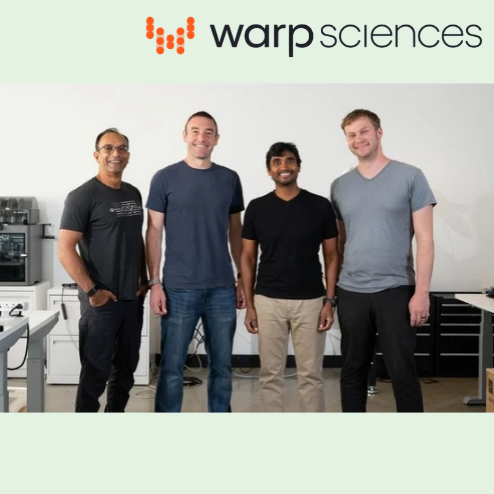
Today we are announcing our investment in Warp Sciences. Warp brings AI, robotics and chemistry together to help the industry discover new medicines faster, and to build the capacity to do that in America. Every experiment runs to a common standard, so the lab learns as it works and, over time, helps scientists reach answers sooner.
The short version of why we invested is simple. Warp does exceptional science for drug developers from the first day, and every experiment makes the next one smarter.
Infinite designs, finite labs
Most ideas worth pursuing never reach the lab bench.
Computation has scaled by orders of magnitude in a generation. Experimentation has not, so the industry tests only a fraction of the ideas worth pursuing.
The slow step is making the molecule. A chemist can design a new compound in an afternoon, but making it usually takes weeks1. Every round of design and testing waits on that step, so programs spend much of their time waiting on chemistry.
The catch is cost. Synthesis and experimentation require a lab, instruments, reagents and scientists. Building a lab mainly to train models means paying for experiments long before there is a paying customer. This approach can work, but it tends to produce binary outcomes.
The right experiments, not just more of them
Value in AI for biology is moving to whoever owns the experiments behind the model.
Models that predict how proteins fold, and increasingly how molecules bind, have become readily available, so a general-purpose model is less of a differentiator. But binding is only the start. The harder questions are how potent and safe a molecule will be and how it can be made. Today’s models still struggle with them. That is not an algorithm problem but a data problem. The models that stay ahead will be the ones that learn from experiments only their builders can run.
Published chemistry data disproportionately records what worked. Failed reactions and their conditions mostly sit inside individual companies, in forms never meant to be learned from. A model trained only on successes is like a student who has only ever seen the answer key. It can recite answers, but it struggles with a question it has not seen.
Historical data has a second problem. It was generated to test someone else’s hypothesis, and sometimes it points to the wrong answer. Early mouse experiments credited IL-12 with autoimmune inflammation, but they could not separate it from a related cytokine, IL-23. Experiments that did so showed that IL-23 drove disease in those models2. That correction led to drugs such as Skyrizi, which gives about three-quarters of psoriasis patients near-complete skin clearance3 and sold $17.6 billion in 20254. More analysis cannot substitute for an experiment that distinguishes competing explanations.
This is a thesis we keep returning to. We back companies that own the data their models learn from rather than renting it. BigHat runs its own design and testing loop for antibodies, and Enveda built instruments and chemistry to read a corner of nature others could not. Both use those loops to discover drugs for their own pipelines and partners. In each case the model improves because the company controls the experiments, including the ones that did not work.
Warp applies the same idea in a different way. Instead of feeding one pipeline, its lab does real science for many drug developers from day one, so what it learns is grounded in the problems the whole industry needs solved.
Built on real work from day one
Warp starts with work drug developers already need, then builds the platform around it.
Warp begins by making variations of promising molecules so scientists can compare them as they search for a drug candidate. It is established work with real budgets behind it. Experienced chemists will lead the work, and Warp plans to support the full scope of what its customers need rather than only the steps that are easiest to automate.
The work itself sets the standard. Every experiment follows a documented protocol on calibrated instruments, with the conditions and results recorded. A research lab treats this as good hygiene. Warp treats it as the product, because it is what makes results reliable, comparable across runs and useful to the next experiment.
Most labs run each project in isolation, so the lessons from one rarely carry over to the next. Warp is built so its lab gets better with every project, learning from what does not work as well as what does. It also plans to run its own experimental campaigns designed to probe where chemistry breaks.
Automation comes in progressively, as the work justifies it, so the lab grows with demand rather than ahead of it. As DJ puts it, “We’re not developing drugs of our own. We’re building the infrastructure for the people who do.” Each stage of the business is designed to fund the next.
Why this works now
Three shifts had to land at the same time.
- Automation became practical. Lab robotics and analytical instruments are now modular and affordable enough to automate a full chemistry workflow on a facility budget.
- Models can now learn more from the data. Today’s chemistry models can use structured experimental records to predict reactions and guide the next experiment across a wider range of problems.
- The demand already exists. Warp is not asking customers to try something new, and many want trusted capacity in the United States for their most sensitive programs.
The fourth ingredient, and the hardest to find, is the team.
A founding team that covers the whole loop
Frontier AI, robotics, data at national scale and real medicinal chemistry rarely sit in one founding team.
Building an AI-run lab requires these skills to work together, from experimental design through execution and model training. Without that, a lab can produce data no model can use, or a model can lack reliable data to learn from. Warp’s team covers all of them.
- Kevin Weil, CEO, was most recently VP of Science at OpenAI and, before that, Chief Product Officer, leading the teams behind ChatGPT, Codex and the OpenAI API. He previously led product at Instagram and Twitter.
- DJ Patil, COO, was the first U.S. Chief Data Scientist, where he worked on the Precision Medicine Initiative and the Cancer Moonshot. He was on the founding team of Devoted Health as CTO and helped coin the term “data scientist.”
- Sol Reisberg, CSO, was VP and Head of Chemistry and CMC at Terremoto Biosciences, where he led the chemistry team to five IND-stage molecules. He earlier held medicinal chemistry roles at Schrödinger and Gilead and trained in Phil Baran’s lab at Scripps. He has been a customer of the kind of lab Warp is now building.
- Manohar Paluri, CTO, spent 14 years at Meta, where he was a founding member of FAIR, led work on the Llama models and most recently served as a VP in Meta Superintelligence Labs. His doctoral research at Georgia Tech was in robotic mapping and perception.
Early hires add robotics experience from Genesis, Skild AI and 1X, and scientific depth from Genentech and Lawrence Livermore National Laboratory.
What stood out to us was how clearly the team named the weaknesses of its own model, starting with the gaps in the data the field has today, and how it built the plan around fixing them.
What we look for, and how we show up
A note for founders building at the intersection of AI and science.
Building a model alongside a lab is hard to get right. These are the four questions we ask every founder who is trying.
- Was your data generated to answer your question? Targeted experiments, run to a consistent standard and checked against reality, are how a model learns what is true rather than what was recorded.
- What does your loop learn that others miss? In chemistry, that is the failed reaction and the conditions behind it. Every field has its own version.
- What number proves it is working? From its first programs, Warp will be able to measure cost per experiment and turnaround time against a known market price. A falsifiable number earns trust faster than a large vision.
- Can each stage stand on its own? A plan where every phase is a real business that funds the next is more durable than one where all the value arrives at the end.
Companies like Warp take patience. The lab has to earn trust before automation pays off, and the largest returns come years later. We invest from evergreen capital, so we are not working to a fund clock. Our team also spends its time in the science, not only on the spreadsheet. We back founders whose ambition is measured in decades, and we stay alongside them through every stage.
A lab that keeps getting smarter
The first steps are concrete, and the ambition is much larger.
In the near term, Warp will stand up its first lab, take on its first customer programs and apply its documentation standard from the first run. Over the medium term, we expect cost per experiment to fall as automation takes on more of the workflow. Over the long term, the ambition is AI that works alongside scientists. A chemist describes the molecule a program needs, and the system designs the experiments, directs the lab and learns its way toward an answer.
The model gets better only if the lab keeps running, and the lab keeps running because it does work drug developers value. We think that is the right order of operations, and we are proud to partner with Kevin, DJ, Sol, Mano and the Warp team as they build it. For the patients waiting on new medicines, a faster path from idea to answer is what matters most.
1 Nippa DF et al. Accelerating compound synthesis in drug discovery: the role of digitalisation and automation. RSC Medicinal Chemistry, 2025;16:5753-5764. See also onepot CORE, an enumerated chemical space to streamline drug discovery, enabled by automated small molecule synthesis and AI. arXiv preprint 2601.12603, 2026.
2 CuaDJ et al.Interleukin-23 rather than interleukin-12 is the criticalcytokine for autoimmune inflammation of the brain. Nature, 2003;421:744-748.
3 GordonKB et al.Efficacy and safety of risankizumab in moderate-to-severe plaquepsoriasis (UltIMMa-1 and UltIMMa-2): results from two double-blind, randomised,placebo-controlled and ustekinumab-controlled phase 3 trials. The Lancet, 2018;392:650-661. In both trials, about 75%of patients on risankizumab reached PASI 90 at week 16, compared with 42% to48% on ustekinumab, with maintenance dosing every 12 weeks.
4 AbbViereports full-year and fourth-quarter 2025 financial results. Press release, February 4,2026.