What is Runway and how is it shaping the future of AI video?
In this conversation, Premji Invest sits down with Cris Valenzuela, Co-Founder & CEO of Runway, to discuss ho generative AI is transforming video creation, simulation, and world modeling. Runway is a leading AI research and product company building state-of-the-art video generation and simulation models. In this interview, Cris shares how Runway's original vision, formed in 2018, has remained consistent as AI video has gone mainstream, and how advances in compute, data, and model design led to breakthroughs like Gen 4.5, one of the most advanced text-to-video models available today.
Key topics covered include:
- The founding vision behind Runway and why video is the next major AI frontier
- How Runway’s video models evolve from text and tokens to frames, physics, and world understanding
- What differentiates Gen-4.5 in realism, prompt adherence, and camera control
- The role of simulation models in media, interfaces, and future software experiences
- Why culture, focus, and research taste matter more than scale in AI innovation
- How Runway serves creators, filmmakers, and enterprises using the same core platform
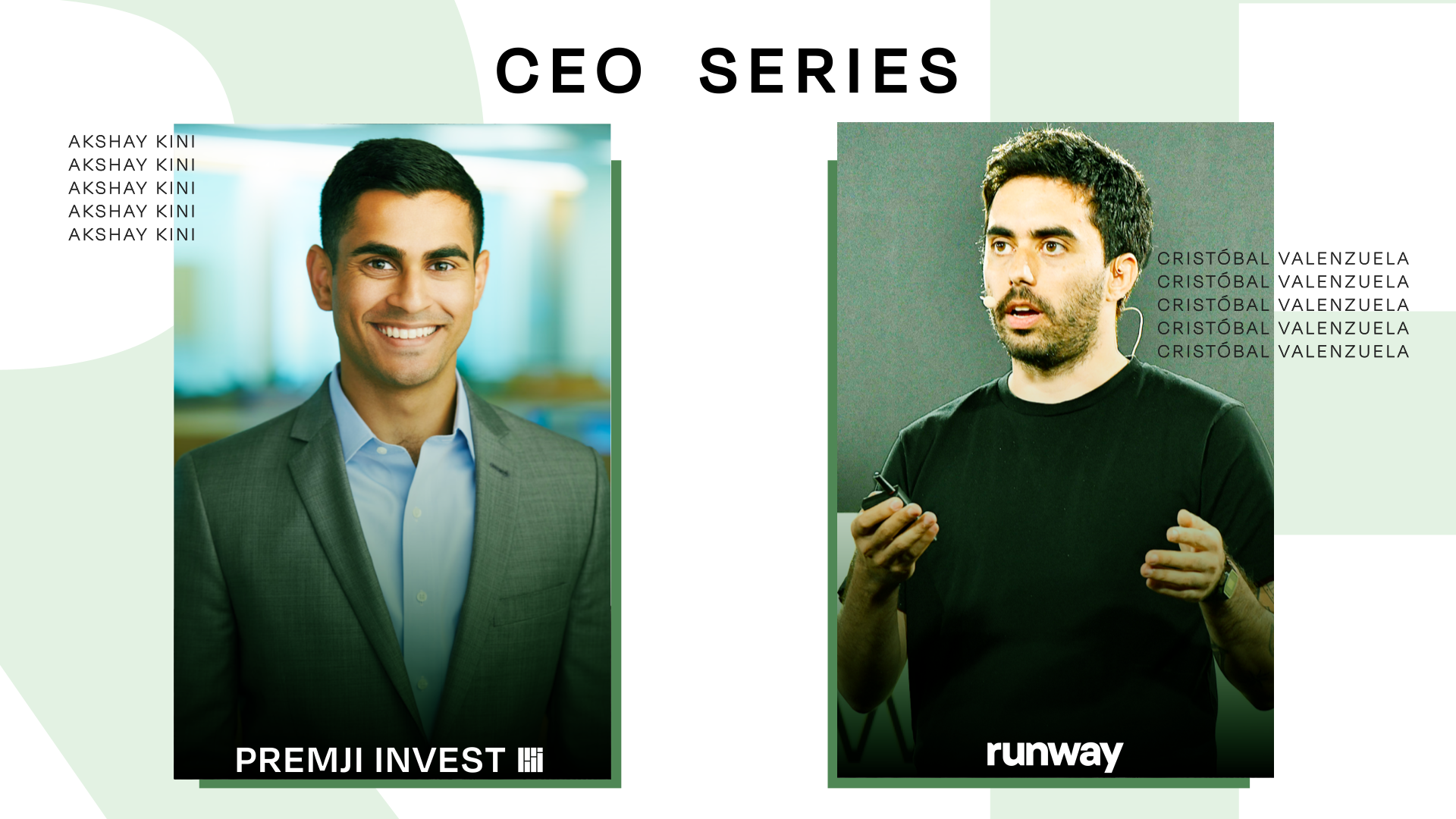
This discussion is part of Premji Invest’s CEO Series, featuring founders and leaders building category-defining technology companies across enterprise, infrastructure, and AI.
Runway is an AI research and product company pioneering generative video and world models used by creators, enterprises, and filmmakers worldwide.
Premji Invest is a $16B+ evergreen crossover fund partnering with founders from inception to IPO and beyond.
**Cristóbal Valenzuela:** [00:00:00] AI is like a great equalizer, and it can allow anyone with, like, access to the internet to, like, u- use state-of-the-art technologies that weren't, like, really imaginable just a couple of years ago.
**Akshay Kini:** Hi, guys. I'm Akshay. I help lead enterprise growth equity at Premji Invest, and this is our CEO series with Chris from Runway.
**Cristóbal Valenzuela:** Hey, uh, I'm Chris. I'm the co-founder and the CEO of Runway. Uh, we've been working on Runway for almost seven years, building the best video and world models.
**Akshay Kini:** Chris, thanks a lot for taking the time.
**Akshay Kini:** Excited to be doing this podcast with you, and Premji Invest is very excited to be partnered with you all. Uh, would love to start with just the genesis of Runway. Uh, so would love to understand sort of what problem did you see back in 2018 that convinced you that the world needed Runway, and how that original thesis has evolved as AI video generation has gone mainstream.
**Cristóbal Valenzuela:** The vision of Runway hasn't really changed, uh, since we started the company seven years ago, which is, which is, uh, I [00:01:00] would say very remarkable. Um, and the vision back then and, and more of a problem that we saw, I, I think we saw an opportunity, which is neural networks and deep learning was starting to work really well across different modalities.
**Cristóbal Valenzuela:** We started to see really good progress in both captioning and video understanding and computer vision. And our bet, our biggest opportunity that we saw back then was, um, and it still is the, the opportunity that we see right now, is using, like, the advantages and the progress of deep learning and AI as the backbone on which you basically generate and simulate anything you want.
**Cristóbal Valenzuela:** We're starting with, with, with the basic. We started with text first. Uh, I think the last couple of years have been, like, very good for language models, but now is the era of video. We're moving beyond just, like- Tokens or tags, and we're moving to frames, to, to world understanding, to physics. Um, and, and, and so the vision of the company has been the same.
**Cristóbal Valenzuela:** It's this idea that you can take these models, if you train them well enough, if you scale them well enough, they're gonna start solving all these, like, problems or, or opportunities [00:02:00] around creating, simulating, generating content. Uh, and now we're getting to a point where it's actually working pretty well.
**Akshay Kini:** So Cris, what I think, uh, we'd love to understand, uh, maybe the evolution of Runway from Gen-1 to Gen-2 to Gen-3, and now Gen-4.5, which has really just blown us away. What has changed under the hood?
**Cristóbal Valenzuela:** That's a good question. I think there's, there's a couple of, like, major changes that I think we've seen over time.
**Cristóbal Valenzuela:** There's, um, uh, first of all, like, um, algorithmic improvements and changes in h- the way we train the models. The second one is the data has been, uh, improved significantly. There's better ways of annotating. There's more data sources. We've also gotten better at, like, uh, kind of selecting and curating when you- how you train the models.
**Cristóbal Valenzuela:** And I would say the third and most important perhaps, uh, is compute. We've, we've gotten more compute, and I mean we, it's like Runway of course, but also the industry at large has gotten much better at building infrastructure that's needed to scale these models. Um, the, the additional aspect I would say of how we particularly have gotten to create the best model in the world right now [00:03:00] with, as you were saying, Gen-4.5, is by, uh, I would say having a lot of good research taste.
**Cristóbal Valenzuela:** And, and taste doesn't come in the form as like of aesthetics or like styles, although definitely that in- involves, but I think it's mostly about what problems do you want to solve and why those problems are important and how you solve them.
**Akshay Kini:** Maybe you can just, uh, help the audience understand a little bit, what are some of the new features that you have in Gen-4.5 that you couldn't do before?
**Akshay Kini:** For example, some of the realistic physics that I've seen, uh, are, are just unbelievable.
**Cristóbal Valenzuela:** Yeah, I mean, the model excels at like, uh, what we call prompt adherence, which is like you can describe a very complex prompt or description or scene with multiple elements, multiple, uh, movements of cameras, and the model will be able to basically follow the instructions of all, everything you're, you're, y- you wanna say and, and you wanna describe, which is kind of a big deal.
**Cristóbal Valenzuela:** A lot of videos these days in previous models have been very static. Camera movements are kind of like traditionally like fixed. This model allows you to go pretty much anywhere you want. [00:04:00] Physics and accuracy of, uh, objects and motions are incredibly like, um, uh, realistic, and so you can use them in hyperrealistic ways or if you're more creative, you're gonna kind of bend the rules of reality in interesting ways as well.
**Cristóbal Valenzuela:** So you have all these very interesting, I would say, applications of, uh, of, uh, of, of these models that are just coming, uh, uh, upfront because the cap- the, the core capabilities are becoming really good.
**Akshay Kini:** That's awesome. And so as the foundation model continues to get better with what you have built at Runway, there's so many directions you can go.
**Akshay Kini:** Do you think the future is gonna be where you ha- a world where you have general purpose video browsers, let's call it, uh, where you have the most performant world models? Or do you think there'll be highly verticalized tools where you have models that are very good with ads versus films versus short-term content, et cetera?
**Akshay Kini:** How do you think the world evolves?
**Cristóbal Valenzuela:** Eventually, these models are simulation systems, and, and when people think about simulation, you think about, I don't know, it can simulate, I don't know, an explosion and a character speaking, all the things that are like, uh, adjacent to film and [00:05:00] media, but you can go definitely beyond that.
**Cristóbal Valenzuela:** Uh, I think we're not too far away from being able to simulate like interfaces and computers and like the way you s- and software and the way you interact with computers, right? Or maybe imagine you wanna learn something. Like I've, I've, every time I wanna learn something, I probably go to YouTube these days.
**Cristóbal Valenzuela:** Imagine a world where you can simulate a personalized experience that's real-time, that teaches you something in the way you wanna learn about it. So I think video models will become pretty much the, the foundations on which a lot of the simulation will, will become, will, will happen.
**Akshay Kini:** Gen 4.5, as we know, is holding a top position as it relates to the ELO ranking on the text to video benchmarks today, which is a phenomenal- Correct
**Akshay Kini:** place to be. Uh, Google's Veo model, one thing that people are arguing is because they have access to a lot of data sets such as, you know, YouTube, et cetera, they may have the ability to train on content that others may not be able to train on. I'm curious if you have a point of view on that. As you think about us hitting the limits on what data we can collect, do you think we have to move towards synthetic data, or what does, how does the data collection process evolve?
**Akshay Kini:** [00:06:00] I
**Cristóbal Valenzuela:** mean, there's definitely a lot of opportunities with like th- synthetic data and something definitely we're exploring. I, I wouldn't say that like video data has been like uh, um, uh, consume in its, in its entirety. I think there's also a point where you can actually use video models to also create more data.
**Cristóbal Valenzuela:** Um, definitely something we're exploring, but, um, I would say the combination different of those efforts will, will lead somewhere interesting.
**Akshay Kini:** You started off with a lot of, let's call it even hobbyists and professional video developers, but have moved towards enterprises, and that's everyone from the Lionsgates of the world to other types of enterprises.
**Akshay Kini:** Maybe you can talk a little bit about how you've seen that evolution over the last couple of years.
**Cristóbal Valenzuela:** AI is, like, a great equalizer, and it can allow anyone with, like, access to the internet to, like, use state-of-the-art technologies that weren't, like, really imaginable just a couple of years ago. And so what happens is that the same product can be equally used by a consumer and, uh, like someone on, on their personal time, and by some of the greatest and most important influential filmmakers in the world.
**Cristóbal Valenzuela:** Like, we have people in, like, Peru, nine-year-olds making videos. We have, [00:07:00] uh, s- like, filmmakers in LA making blockbuster movies. We have, uh, people in Japan making, like, anime. Like, we have people in, like, uh, just, like, everyone uses Runway in some way, and there's no boundaries, and that's the beauty of it. Like, the models can just generalize to a bunch of different tasks.
**Akshay Kini:** So what does Runway need to do to be clearly better and deserve to win this race? Like, fast-forward three, four years from now, how do you guys continue to stay at the top of those leaderboards? Right? I feel like every few months that can keep changing.
**Cristóbal Valenzuela:** I think the way we manage to keep up, and I think this is true for startups, for AI companies, for any companies, you need to, you need to have a vision, and you need to be really good at and relentlessly executing that vision regardless of what happens.
**Cristóbal Valenzuela:** You need to be very good at having an idea of where you want to see in the world and pursuing that, uh, as much and as, uh, as, as, as, as, as deep as you can. And, and look, when we started this, no one really cared about video models. No one took it seriously. We're the only and the best because there was no one else.
**Cristóbal Valenzuela:** Eventually now everyone [00:08:00] is like, now we're competing with the biggest and, like, most well-funded companies in the world, yet we're still winning. And that still winning, I wouldn't say it's because of resources. We're definitely, like, less resourced than they are, and I think it's because you have a consistent cultural vision and a consistent, like, way of getting there, and i- there's enough intuition and, like, experience within the team of how they can get there.
**Cristóbal Valenzuela:** I think that eventually compounds to, to, to winning and to being the lead here.
Recommended

Formal verification just left the lab. Why we invested in Pramaana Labs.

Formal verification just left the lab. Why we invested in Pramaana Labs.
CEO Series | Enveda: Building a 21st century generational pharma company.
CEO Series | DOSS: Turning operational complexity into competitive advantage

Why I take founders on a 3-mile hike before writing a check