
Few companies in AI-driven biology have carried a molecule of their own into a patient. Fewer still have done it on a format most of the field has not attempted. BigHat Biosciences has done both, and today it announced a $75 million Series C, co-led by Premji Invest and DFJ Growth, to do it again.
BigHat is an AI-native biotech that pairs frontier AI with an autonomous, high-throughput wet lab to design and develop next-generation protein therapeutics. Its platform has now produced two wholly owned programs: BHB810, a CDH17-directed antibody-drug conjugate for gastric and other gastrointestinal cancers that is already in patients, and BHB299, an avidity-driven CEACAM6 T-cell engager for solid tumors that is completing preclinical development, ahead of human trials in early 2027. Around them sit collaborations with Amgen, Merck, Johnson & Johnson, AbbVie and Eli Lilly, and partnerships with leading frontier AI companies. Biologics are roughly half of the addressable drug market, and BigHat is one of very few companies that can point to a clinical pipeline, validation with pharma and frontier AI companies, and a proprietary integrated data engine at the same time.
Why biologics fail, and why that is the opportunity
Biologics rarely fail in the clinic because they cannot bind a target. They fail because they lack the properties that turn a promising binder into a safe and effective medicine: internalization, selectivity between tumor and healthy tissue, a safety window wide enough to dose, and the developability and manufacturability that let a molecule survive CMC and an IND. The industry has spent tens of billions of dollars learning this. Rova-T died on payload toxicity, TGN1412 on cytokine release, solitomab on a therapeutic window that never existed. In each case the target was right and the molecule did what it was designed to do. What failed was a property nobody had written into the specification.
BigHat treats binding, developability and function as one joint design challenge rather than three sequential ones, so that the biological need and the modality built to meet it are aligned from the first design cycle. The properties that kill drugs are written into the objective from day one, engineered in on every molecule at scale, and measured on purified protein rather than inferred. Crucially, that matters more now than it did a decade ago. Most of the targets reachable with a conventional monoclonal antibody have been picked, and the next phase of drug discovery depends on formats and functions that antibodies have not traditionally had: conditional activation, avidity-driven selectivity, payload delivery, logic gating across two antigens. Those are formats where a good binder is the starting point rather than the answer, and BigHat is purposefully built to design for them. That is the discipline of a drug company applied at the speed of a machine learning loop, and it is why BigHat has a molecule in patients.
How Premji Invest evaluates AI-native drug discovery companies
At Premji Invest, we spend a lot of time on AI-native drug discovery, and our view has narrowed to something fairly specific. General-purpose models and agents are commoditizing quickly; a state-of-the-art model gives you a head start, not a business. What does not commoditize is the closed loop of design, make, test and learn, the proprietary data it generates on hard problems, and the clinical judgment that decides which problems are worth solving. When we underwrite a company in this space, we focus on four things:
- Loop velocity. How fast does a design become data, and how fast does that data retrain the model? A platform’s real value is its learning rate.
- Proprietary data on hard problems. Is the company generating fit-for-purpose, multi-parameter data on molecules that are trying to become drugs, or fine-tuning on binding data everyone else can download?
- Decision advantage. Can it kill inferior candidates in silico and in weeks, before spending months and millions in the lab and years in the clinic?
- Dated clinical milestones with a capital path to reach them. In biotech, undercapitalized programs fail about as often as bad science does.
BigHat is the clearest expression of that framework we have found in biologics.
The loop: One week from design to data
What slows AI down in biology is the absence of task-specific, high-quality data. BigHat solves this by making its own, at scale.
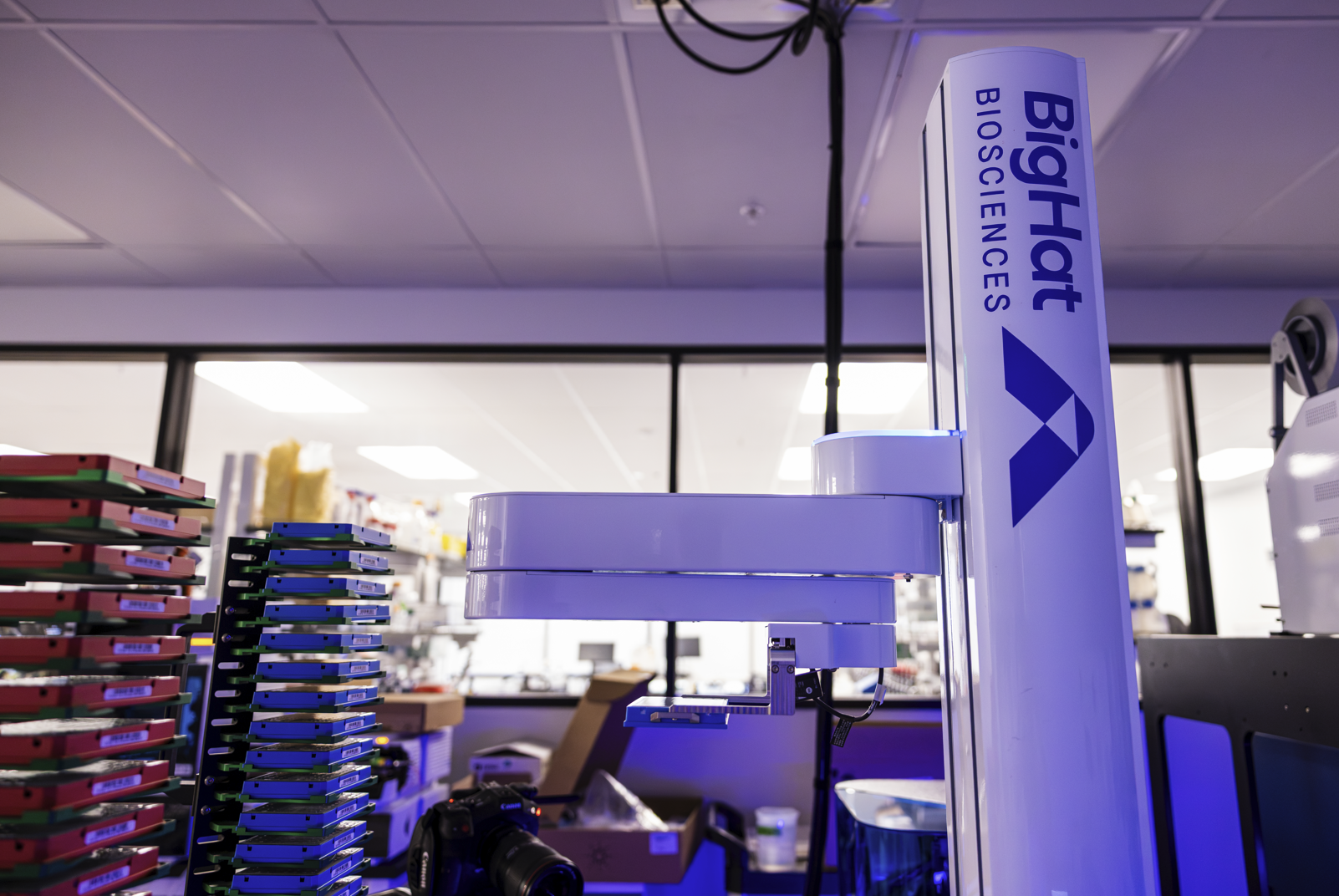
- Integrated AI and wet lab. BigHat’s platform processes 2,000+ antibodies per week and measures more than ten properties on every one of them, on the same purified molecule. Paired multi-parameter measurements are a different and far more useful training object than a pooled binding screen, because a frontier model designing a drug has to respect several design constraints at once.
- Weekly cycles. BigHat goes from design to data in about a week, an industry-leading cycle time that supports roughly 40 design-make-test-learn cycles a year against the two to four a traditional group manages. Every cycle reduces model uncertainty on exactly the question that matters.
- Failure data. Nobody publishes the molecule that aggregated, or the format that lost function on reformatting. BigHat runs those molecules, records why they failed, and feeds the answer back into the next design cycle. Public and partner datasets are almost entirely positive results; BigHat’s includes the negatives, which is where most of the learning is.
This is the piece we keep coming back to. No company measures self-association, viscosity, CMC-scale expression or tox-relevant behavior unless it is trying to make a drug. This dataset is downstream of BigHat’s clinical discipline rather than a substitute for it, and that is why BigHat’s dataset advantage compounds with every program the company runs.
What the loop makes possible
Speed is only half of it. Running the loop this fast changes what can be designed at all, because it lets you optimize for many properties at once instead of trading them off in sequence, and it lets you take on formats where design quality determines whether a target is druggable at all.
- Hard problems, not repeated problems. BigHat’s programs each solve a different class of design constraint: an ADC that must be internalized and trafficked correctly to release its payload, a T-cell engager whose selectivity comes from avidity and two-arm geometry rather than from either binder alone, and logic-gated multispecifics that fire only in the presence of the right combination and stoichiometry of antigens. Binder generation has advanced enormously across the field – BigHat goes beyond it.
- Multi-objective optimization. Affinity, stability, expression, aggregation, immunogenicity and function are optimized jointly, which is how you get a developable drug that works as intended.
- Complex modalities. Multispecifics, T-cell engagers and ADCs: the formats where sequence-only models have the least to say and where almost no public training data exists.
Pharma partnerships and a wholly owned pipeline
BigHat pairs a wholly owned pipeline with pharma partnerships, which deliberately blunts the binary risk of an asset-centric biotech and provides the most credible external validation available.
- Partner of choice. Collaborations with Amgen, Merck, Johnson & Johnson, AbbVie and Eli Lilly, including a completed strategic collaboration with J&J, three project collaborations with Merck, and an expanded relationship with Lilly that now includes machine learning-enabled biologics discovery through Lilly TuneLab. In a market where AI discovery deals still command only a small share of total deal value upfront, repeat business and expanded scope from partners of this caliber is the signal that carries weight.
- Frontier AI partnerships. BigHat has also formed partnerships with leading frontier AI companies to generate high fidelity, fit-for-purpose training data and deploy state-of-the-art models for agentic therapeutic design. The reason those labs come to BigHat is instructive: binding is close to a solved benchmark, and the unsaturated question is whether a model can design molecules that survive everything else. BigHat is one of the few places where that question can be scored at scale.
- A pipeline built on validated biology. BigHat applies the platform to targets where the biology is well understood and earlier programs failed on molecular properties rather than on mechanism, so the variable being tested in the clinic is design quality. BHB810 dosed its first patient in July 2026; BHB299 is expected to enter the clinic in 2027.
That last point is why the timing matters to us. The market still prices AI-native pipelines at legacy biotech success rates, even as early evidence suggests AI-discovered assets have cleared Phase 1 at higher rates than the historical average. We think that gap closes as clinical data accumulates, and we would rather own the company generating that data than wait for the consensus to move.
What’s next
Under CEO Peyton Greenside, BigHat has assembled a team that is rare in this field: protein engineering, AI, lab automation and clinical development under one roof, with the experience to carry molecules through GMP, an IND and a first-in-human study rather than hand them off. Becoming a clinical-stage company is a step change, and it puts BigHat at the front of the field at exactly the moment the field is being asked to prove that AI-designed biologics can become successful medicines.
At Premji Invest we seek to partner with teams that think big and have the discipline to build enduring companies. BigHat is exactly that, and we are proud to co-lead this financing alongside DFJ Growth and to support Peyton and the team as they bring transformative medicines to patients.
If you are building a company at the intersection of AI and therapeutics, we would like to hear from you.
Recommended
Beyond binding: why we co-led BigHat Biosciences’ Series C
Beyond binding: why we co-led BigHat Biosciences’ Series C
.jpg)
Agents need more than intelligence. Why we invested in Databricks
Agents need more than intelligence. Why we invested in Databricks


The Downstream Effects of SpaceX, OpenAI, and Anthropic Soaking Up $3T in the Public Market, Who Is Netscape and Who Is Google in the AI Era, and the Impact of Private Credit Redemption Requests on PE and VC (Sandesh Patnam)
The Downstream Effects of SpaceX, OpenAI, and Anthropic Soaking Up $3T in the Public Market, Who Is Netscape and Who Is Google in the AI Era, and the Impact of Private Credit Redemption Requests on PE and VC (Sandesh Patnam)

Robotics isn’t having its ChatGPT moment just yet